
STAKEHOLDER TRUST • AUGUST 2026
The First Shovel is Too Late: Data Centers Need to Earn Community Trust Before They Break Ground
Data centers need more than power, land and permits to succeed. They need community trust—and the work to earn it should begin long before construction does.
By Caryn Whitney • Founder & Principal Advisor, Whitney Advisory Group
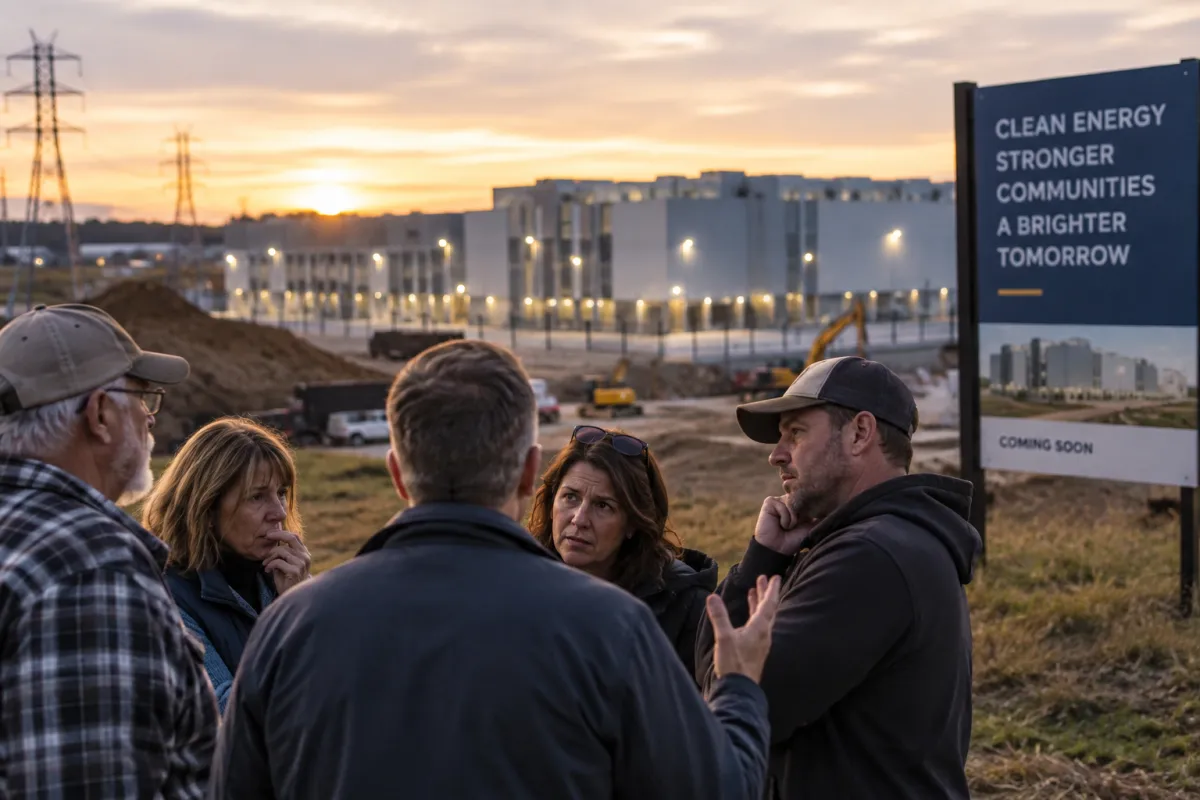
Community opposition is no longer just a communications challenge. It is becoming a project, permitting and financial risk.
For years, the data-center development equation was largely about finding the right land, sufficient fiber, available power, financing and a path through permitting. I believe another asset now belongs on that list:
Trust.
And unlike land or electricity, it can't simply be secured through a contract.
It has to be earned. The evidence that this matters to the business case is becoming increasingly difficult to ignore.
According to Reuters reporting published August 10, lenders financing the U.S. data-center boom are increasing their scrutiny of projects as community and political opposition grows. Reuters reported that at least 75 U.S. data-center projects representing roughly $130 billion encountered opposition in the first quarter of 2026. That matters. What might once have been viewed primarily as a public-relations issue is increasingly becoming a project risk—and potentially a capital risk.
For CEOs, developers, investors and communities, that should change the conversation.
The Public Is Sending a Message
Data centers are becoming essential infrastructure for an increasingly digital and AI-driven economy. They are also arriving at a scale many communities have never experienced. The Electric Power Research Institute's 2026 Powering Intelligence analysis projects that data centers could consume 9% to 17% of U.S. electricity by 2030, up from roughly 4% to 5% today.
Communities see that growth. But many don't yet understand what it means for them.
Will my electric bill increase?
Where will the electricity come from?
Will our water supply be affected?
What happens to surrounding property?
What will we hear?
How many permanent jobs will actually be created?
What does our community receive in return?
And perhaps the most important question: Why weren't we part of this conversation earlier? The level of public concern is striking. Gallup found in May 2026 that seven in 10 Americans opposed construction of an AI data center in their local area, including 48% who strongly opposed it. Only about one-quarter favored such a project. That isn't something industry leaders should dismiss as a communications problem that better talking points will solve. It's a warning about trust.
Facts Matter. But Facts Alone Don't Create Trust.
Electricity costs are a good example. There is understandable anxiety that enormous new electric loads will automatically mean higher bills for existing customers. But the economics are more complicated. A 2026 study by researchers Asa Watten, John Bistline and Geoffrey Blanford examined U.S. data-center growth and electricity rates from 2015 through 2024. The researchers concluded that data-center growth had, on average, modestly reduced rather than increased retail electricity prices over the period they studied. Their preferred estimate found that a doubling of data-center capacity was associated with about a 3.5% reduction in residential retail prices, in part because additional electricity sales can spread the grid's large fixed costs across more kilowatt-hours. But here's the part leaders shouldn't leave out: The researchers explicitly warn that the future could be different.
Supply constraints could reverse the effect. And if utilities build infrastructure for anticipated data-center demand that ultimately doesn't materialize, those fixed costs could be spread across fewer customers and fewer kilowatt-hours.
That's an important distinction. Trust isn't built by finding the statistic that wins your argument.
It's built by being willing to say: Here's what we know. Here's what we don't know. Here's the risk. And here's what we're going to do to protect you from it. The policy conversation is increasingly reflecting that concern.
The White House Ratepayer Protection Pledge calls on participating technology companies to pay the costs associated with the energy and infrastructure required by their data centers rather than shifting those costs to existing consumers. And in June, the Federal Energy Regulatory Commission ordered all six regional grid operators under its jurisdiction to justify or reform their rules for connecting data centers and other large energy users to the grid. FERC explicitly framed its action around accelerating large-load integration while protecting ratepayers. The technical and regulatory conversation is changing rapidly. The community-engagement model needs to change with it.
Stop Treating Engagement as Something That Happens After the Decision
This is where I believe many major infrastructure projects get the sequence wrong.
The company identifies the site.
Negotiations begin.
Economic-development officials become involved.
Confidentiality agreements limit discussion.
Engineering advances.
Incentives are negotiated.
The project becomes increasingly real.
And then the public learns about it.
From the company's perspective, the project may be at the beginning of the public process. From the community's perspective, decisions have already been made without them. That's where distrust begins. A public hearing cannot necessarily repair months—or years—of perceived exclusion. A fact sheet can't overcome the feeling that somebody else decided what was going to happen in your backyard before anyone asked what mattered to you. And a communications campaign is not a substitute for a relationship.
What Should Happen Before the First Shovel Hits the Ground?
I believe data-center companies should treat community trust with the same discipline they apply to land, power, engineering and financing.
Listen before you persuade. Before presenting the benefits of a project, understand what the community values, fears and wants to protect. That means listening not only to elected officials and economic-development leaders, but also to adjacent landowners, residents, small businesses, schools, first responders, community organizations and other trusted local voices.
Understand the stakeholder landscape before opposition organizes it for you. Map who has influence, who has concerns, where information gaps exist and which issues could become emotionally significant.
Show the community math. Don't simply announce a billion-dollar investment. Explain what it means locally. Who pays for new electric infrastructure? What happens to rates? How much water will be required? What tax revenue is created? How many construction jobs and permanent jobs result? What infrastructure improvements remain after construction?
Communities deserve enough information to decide whether the value proposition makes sense for them.
Align the organizations speaking to the community. A developer, utility, local government, economic-development organization and elected official cannot tell five different versions of the same story.
Misalignment creates information vacuums.
Information vacuums create rumors.
And rumors can become narratives remarkably quickly.
Make commitments people can see. Trust grows when people can point to evidence: infrastructure investments completed, local workers hired, water commitments met, electric-rate protections honored, noise standards verified, community investments delivered and concerns addressed. In other words: Don't ask communities to trust your intentions. Give them reasons to trust your behavior.
Understanding Has to Come Before Persuasion
My perspective on this issue comes from both sides of the conversation. I spent nearly two decades as a journalist, including as an Emmy Award-winning television journalist and newsroom executive. My job was to ask difficult questions, challenge assumptions and help people understand complicated issues that affected their lives. Later, I moved to the other side of the table as an energy industry communications executive, advising leaders through complex issues involving electricity, grid reliability, infrastructure investment, public policy and, increasingly, data-center growth. But one of the most important lessons I carried from journalism into the executive suite was this:
Trust is rarely earned when you need something from someone. It's earned in all the interactions that came before.
As a journalist, I saw that firsthand. I covered crime and the courts for many years. I built relationships with law enforcement officers, crime victims and families experiencing some of the most difficult moments of their lives. People sometimes chose to talk with me when they wouldn't talk with another reporter—not because I could make the situation easier, but because I had taken the time to listen, treated them fairly and earned their trust. That lesson stayed with me when I became a leader and later an executive advisor.
Whether you're asking an employee to embrace significant change, a regulator to understand a complicated decision or a community to support a major infrastructure project, you can't begin building trust at the moment you need someone's support.
And you can't communicate your way around the absence of it.
During my time working across Ohio's electric cooperative system, I saw firsthand how rapidly data-center development was changing conversations about electricity demand, grid reliability, infrastructure investment and who should bear the costs of serving enormous new loads. Those experiences reinforced for me that the challenges surrounding data centers aren't purely technical, financial or regulatory. They're human. Residents don't experience a proposed data center as a load forecast, an interconnection request or an economic-development announcement. They experience it through questions about their electric bill, their water, their property, their community and what the development could mean for their family's future.
Those questions deserve factual answers. But they also deserve to be heard before decisions appear to have already been made.
That's why I believe the companies that ultimately succeed in building the infrastructure our increasingly digital economy requires will be the ones that treat community trust as seriously as they treat power, land, fiber, financing and permitting.
Trust is infrastructure, too. And it needs to be built before the first shovel hits the ground.
Trust is a Business Asset
Organizations build trust over time through listening, transparency, consistency, relationships and visible follow-through.
And when a difficult decision comes, organizations either have trust to draw upon—or discover they never built enough of it.
For leaders, that makes trust more than a communications objective. It makes trust a business asset.
When trust is strong, it can create room for difficult conversations, help leaders navigate uncertainty and make it easier for stakeholders to believe an organization when the answers aren't simple.
When trust is weak, the opposite can happen. Questions become suspicion. Information gaps become narratives. And decisions that may be technically, financially and operationally sound can become much harder to move forward.
That's one reason I created Whitney Advisory Group and developed the EarnTrust™ Framework.
I help executives and organizations—particularly those navigating energy, infrastructure, AI and data-center development—identify stakeholder risk early, understand community perceptions, align leadership, develop clear narratives, engage stakeholders meaningfully and demonstrate that commitments are being kept.
The objective isn't to create a better campaign for defeating community opposition.
It's to create a better process for earning community trust before opposition becomes a material business risk.
Because the first shovel shouldn't mark the beginning of a company's relationship with a community.
By then, the relationship should already exist.
Sources & Further Reading
Reuters, Aug. 10, 2026: Lenders scrutinize U.S. data center financing as community opposition builds Read the Reuters report
Gallup, May 13, 2026: Americans Oppose AI Data Centers in Their Area Read the Gallup research
Electric Power Research Institute, 2026: Powering Intelligence: Updated Scenarios of U.S. Data Center Electricity Use and Power Strategies Read EPRI's analysis
Watten, Bistline & Blanford, 2026: Have Data Centers Raised Your Electric Bill? Causal Evidence from the United States Read the EPRI research
Federal Energy Regulatory Commission, June 18, 2026: FERC Launches Aggressive Targeted Action to Speed Large Load Integration Read FERC's announcement
White House, March 4, 2026: Ratepayer Protection Pledge Read the Ratepayer Protection Pledge
Quick Links
Legal & Compliance
The EarnTrust™ Framework
© 2026 Whitney Advisory Group LLC. All Rights Reserved.
EarnTrust™ is a trademark of Whitney Advisory Group LLC.