STAKEHOLDER TRUST • AUGUST 2026
Nuclear May Be Part of the Answer to America's Power Problem. But First, We Need to Talk About It.
America needs more reliable, baseload power. Advanced nuclear could be part of the answer—but moving from promise to deployment will require more than technology. It will require public understanding and trust.
By Caryn Whitney • Founder & Principal Advisor, Whitney Advisory Group
We don't need a better name for nuclear. We need a better conversation about nuclear.
America's demand for electricity is entering a period unlike anything we've experienced in decades.
AI. Data centers. Advanced manufacturing. Electrification. An increasingly digital economy that never turns off.
But “data centers” can sound like something happening somewhere else—a massive building filled with servers that most of us will never see. The reality is much closer to home.
Check your bank balance. Open MyChart. Stream a movie. Upload a photo from your phone. Ask your GPS for directions. Book a flight. Join a video call. Order something online. Ask an AI assistant a question. Behind virtually every one of those everyday interactions is digital infrastructure—servers, networks, cloud computing and data centers processing, storing and moving enormous amounts of information. We may never see that infrastructure. But we all use it. And it all requires electricity.
Increasingly, a lot of it.
Consider what's happening in PJM, the nation's largest electric grid. According to PJM's 2026 Long-Term Load Forecast, summer peak electricity demand is projected to grow from about 160,000 MW in 2027 to 191,000 MW by 2031.
That's more than 30 GW of additional peak demand in just four years. PJM says data centers and other large loads are significant drivers of that growth. How much is 30 GW? For perspective, New York Independent System Operator data show that New York City's electricity demand can exceed 10 GW at peak. So we're talking about adding the equivalent of the amount of electricity it takes to power New York City at peak demand—nearly three times over. And that's just a few years away.
Where will the power come from?
That's becoming one of the most important infrastructure questions in America. Electricity supply and demand must remain in balance. If we don't build—or preserve—enough dependable generation to keep pace with rapidly growing demand, reliability becomes the issue. And the alternative isn't something any of us wants to contemplate: power shortages and potentially blackouts. Especially on the coldest night of winter or the hottest day of summer. At the same time, we want what I consider the gold standard for electricity: Reliable. Affordable. Clean. Getting all three isn't simple.
Wind and solar will remain important parts of the generation mix. Natural gas will play a role. And maintaining the existing generation resources we need—including coal and nuclear—will matter as we navigate rapidly growing electricity demand without compromising reliability. PJM has been warning about the fundamental mismatch: electricity demand is rising, existing generation is retiring, and replacement generation isn't coming online quickly enough. Which brings us to a word that can immediately change the conversation.
Nuclear.
What did you picture when you read that word? For many Americans, the word “nuclear” immediately brings to mind an image:
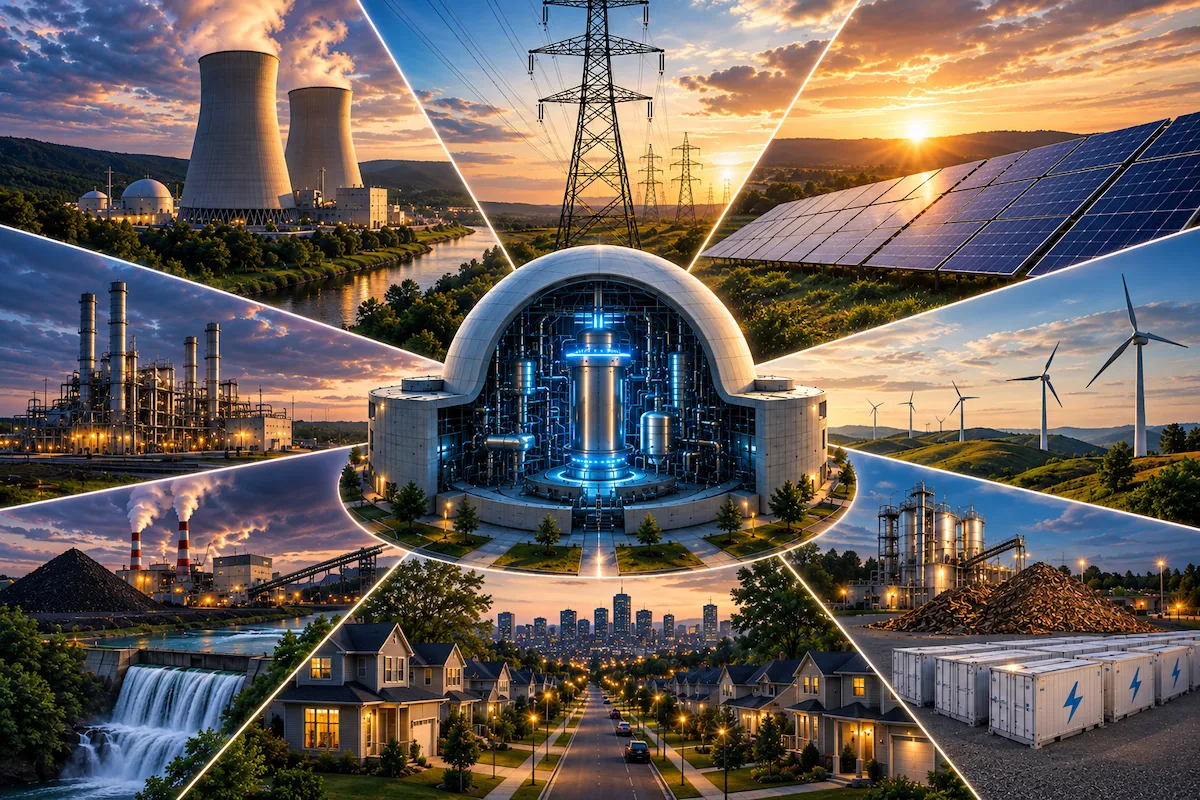
Massive power plants and cooling towers. Radiation. Accidents. Enormous reactors and multibillion-dollar projects that can take years—or decades—to plan and build.
But that's not the whole picture of nuclear power anymore.
Today's advanced nuclear technologies are being designed across an entirely different range of scales. Some small modular reactors, or SMRs, are being designed at around 300 MW—roughly a third the output of a traditional large reactor—and are intended to be more compact and scalable.
The U.S. Nuclear Regulatory Commission notes that advanced reactors may incorporate innovations such as passive safety features, alternative fuels or coolants, and smaller reactor sizes. For example, the BWRX-300 now in pre-application activities with the U.S. Nuclear Regulatory Commission is a roughly 300-MW small modular reactor with passive safety features.
Go smaller still and you get microreactors.
Here's an example that puts “micro” into perspective: The Radiant Kaleidos microreactor now in pre-application activities with the U.S. Nuclear Regulatory Commission is designed to generate approximately 1 MW of electricity and be fully contained in a single shipping container. How much is 1 MW? If a 1-MW reactor operated continuously, it would produce enough electricity over the course of a year to equal the annual electricity use of roughly 800 average U.S. homes, based on U.S. Energy Information Administration residential electricity data. Think about that: a nuclear reactor designed to fit inside a shipping container, capable of producing the annual electricity equivalent of hundreds of homes. That's a very different picture of nuclear. But how many people outside the energy industry know that? And that's where we have a communications challenge.
The technology may be changing faster than public perception.
If advanced nuclear is going to become a meaningful part of America's future generation portfolio, communicating about it can't begin when someone announces plans to build a reactor. By then, people may already have made up their minds.
And I don't think the solution is finding a better name for nuclear. Do we call it something less intimidating? Give SMRs or microreactors a friendlier label? Avoid the word altogether? No.
That might make communications easier in the short term, but it doesn't build trust. Trust isn't built by finding a euphemism for something people find uncomfortable. It's built by explaining it.
Show people what an SMR actually is.
Show them its size.
Explain how it works.
Explain how it differs from the nuclear plant they may be picturing.
Talk about safety—and don't dismiss questions or concerns about it.
Explain the waste issue.
Explain the economics.
Explain the benefits.
Explain the tradeoffs.
Explain what nuclear can do—and what it can't.
And put all of it into the context of the larger question:
Where is the electricity America will need five, ten and twenty years from now going to come from?
Don't start with “Trust us.”
One of the biggest mistakes organizations can make when communicating complicated or controversial technology is beginning with the conclusion they want stakeholders to reach. “We need this.” “It's safe.” “Trust us.” That's backwards. Start with people's questions.
I spent more than two decades as a journalist before moving into energy communications and advising executives. That experience shaped how I approach complex, high-stakes issues today: I think like a journalist before I advise like an executive.
Because a journalist isn't starting with the message an organization wants to deliver. A journalist is asking the questions everyone else will ask.
What doesn't make sense?
What hasn't been explained?
What's the risk?
Who benefits?
Who pays?
What happens if something goes wrong?
What aren't you telling me?
Those are often the same questions employees, customers, policymakers and communities are thinking.
And if leaders can anticipate and answer those questions before a major decision becomes a communications problem, they have a much better opportunity to earn trust before that decision becomes a business risk.
So when it comes to advanced nuclear, start there:
What is it?
Why do we need it?
How is it different from the nuclear plants I've heard about?
What happens if something goes wrong?
What happens to the waste?
How much will it cost?
Why would you put one in my community?
What's in it for the people who live here?
Those aren't obstacles to overcome.
They're legitimate questions that deserve credible answers.
And sometimes the answer should be:
We don't know yet.
Credibility isn't built by pretending there are no risks or tradeoffs. It's built by being transparent about them.
Start the conversation before you need permission. This may be the most important communications lesson of all.
If the first time a community seriously learns about advanced nuclear is when they're being asked to support a reactor near their homes, we've waited too long.
Public education shouldn't begin with a project announcement.
Neither should trust. Communities need opportunities to understand emerging energy technologies long before they're asked to take a position on a specific project. Let people see the technology. Let them ask difficult questions. Bring engineers into the conversation—but teach them to explain the technology in language normal people understand. Bring independent experts into the conversation. Talk openly about safety, cost, waste and risk. And listen.
Because communication isn't simply about helping people understand what the energy industry wants to build.
It's also about understanding what people need to know before they're comfortable considering it. This isn't only an engineering challenge. America is going to need enormous amounts of new electricity. Exactly what the generation mix looks like is still being determined. But increasingly, advanced nuclear appears likely to be part of that conversation.
Which means one of the biggest challenges ahead may not be technological. It may be trust.
Before people can support something, they need an opportunity to understand it. Before they can understand it, someone needs to explain it. And before we explain it, we need to listen to what they're actually worried about. We don't need a better name for nuclear. We need a better conversation about nuclear.
And that conversation needs to start now.
Sources & Further Reading
PJM Interconnection — 2026 Long-Term Load Forecast
New York Independent System Operator — New York City (Zone J) Peak Load Data
U.S. Nuclear Regulatory Commission — Advanced Reactors
U.S. Nuclear Regulatory Commission — BWRX-300 Small Modular Reactor
U.S. Nuclear Regulatory Commission — Kaleidos Microreactor
U.S. Energy Information Administration — U.S. Residential Electricity Data
Quick Links
Legal & Compliance
The EarnTrust™ Framework

© 2026 Whitney Advisory Group LLC. All Rights Reserved.
EarnTrust™ is a trademark of Whitney Advisory Group LLC.